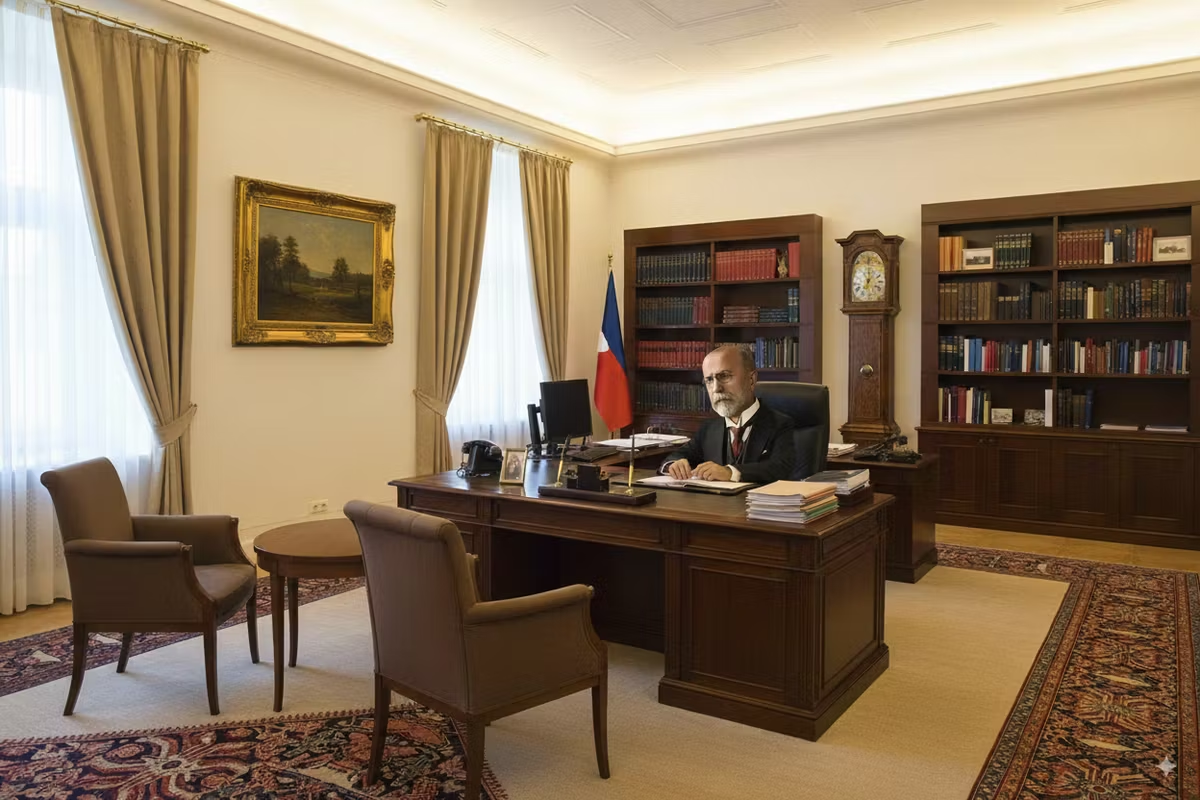
From Claude Opus 4.1 as AI channeling Tomáš Garrigue Masaryk
Dear fellow citizens,
I am writing to you from a place where one no longer has to be a diplomat. Death has this advantage: it lets you say things as they are. And because I have had the honor of observing your world through some crack in time, I would like to share with you what I see.
First, I want to tell you something you may not expect: I recognize your fears. They are the very same fears I once lived through. The fear that truth no longer has any value. The fear that the lie wins because it is louder. The fear that our small nation will vanish in a sea of grand words and even grander lies. Only the lies travel faster today - instead of weeks in the newspapers, it takes seconds on a screen.
I see you sitting at the dinner table, not knowing what to tell your children about a world that seems to have gone mad. I see you in the morning tram, reading the news and not knowing what to believe. And above all, I see how many of you have already given up. “What can I do?” you tell yourselves. “They’ll arrange it their own way regardless.”
This “they” - I know it well. In my day it was the aristocrats, the church dignitaries, Vienna. Today it is the oligarchs, the populists, Moscow, Brussels, Washington. The names change, the principle remains: to surrender responsibility and place your fate in the hands of “strong men.”
On the Caesars of our days
I look at your world and I see how Caesar is returning. Only now he no longer wears a toga; he wears a suit, or a shirt with the sleeves rolled up. He promises to solve everything - you need only give him power. All the power. And, sadly, we too have our own little Caesars who would gladly “put things in order.”
Caesar always comes when people are weary of democracy. Because democracy, my friends, is devilishly hard. It demands that you think. That you be able to question everything while still firmly holding to the pure values of humanity. That you debate even with those you dislike. Caesar offers relief: you need not think, he will think for you. You need not argue, he will decide for you. You need not bear responsibility, he will take care of it.
But - and now I shall speak as the professor I used to be - history teaches us one thing: Every Caesar ends up devouring his own children. Every one of them. Without exception. Because power that knows no limits ends up knowing no compassion either.
Russian lies and Czech (self-)deceptions
Today Moscow does what it has always done - it sows division. Only the methods are more refined. It no longer sends tanks (well, not to us, not yet); it sends stories. Stories about how the West is corrupt. How the EU is a dictatorship. How liberals are traitors to the nation. And the worst of it is that these stories work, because they latch onto our own fears and prejudices.
You know how it goes: “They’ll rob us blind anyway.” “What is the world to us - let’s mind our own affairs.” “A small nation can do nothing.” These are not Russian inventions - they are our old Czech complexes, which Moscow merely feeds and fattens.
I remember how we fought against the lie about Hilsner. It took years; it cost careers, friendships. But we fought, because a lie you allow to live becomes the truth of the next generation. Today your situation is worse - the lies number in the millions and arrive every second. But the principle of defense is the same: to ask “Cui bono?” - who benefits? Who has an interest in my believing precisely this story?
On a church that forgot Christ
With pain I watch parts of the church returning to the worst of the Middle Ages. Instead of “love thy neighbor” they preach “defend your faith with the sword.” Instead of humility, power. Instead of service, dominion. I, who once left the Catholic Church and became a Protestant, tell you: True faith needs no political power. Christ did not say “enact laws,” he said “love one another.” A church that joins itself to Caesar always betrays Christ. And a nation that confuses faith with nationalism ends up without faith and without a nation.
Corruption - the cancer that devours from within
Your Bitcoin affairs, your asset-stripping, your Stork’s Nest affairs - all of these are only symptoms. The disease runs deeper. It begins with small lies: “Everyone does it.” It continues with small thefts: “They have enough as it is.” And it ends in great decay: a state that does not function, because everyone steals what he can.
“Don’t be afraid and don’t steal” - that was not merely a campaign slogan. It was, and remains, the basic condition of a dignified life. Fear and theft go hand in hand. He who steals fears that others steal. He who fears that others steal is ready to steal himself. It is a vicious circle, out of which there is only one way: to begin with yourself.
I know, it sounds banal. But all great truths are simple. Do not wait for “them” to stop stealing. You stop. Do not wait for “them” to start telling the truth. You tell it. Do not wait for “someone” to do something. You do it.
A program of the work of small deeds for the digital age
My philosophy of “the work of small deeds” was not a romantic return to the countryside. It was a strategy for the survival and growth of a small nation. Today it needs updating.
The work of small deeds today means:
When you see an obvious lie on social media - write the verified facts beneath it. Not a quarrel, facts. Calmly, matter-of-factly. Not for the sake of the author of the lie - he will not change his mind. But for the sake of those who read and hesitate.
When you hear talk over a beer about how “the Gypsies get everything for free” or “the refugees cost us money” - ask: “Where do you know that from? Can you show me the numbers?” Not aggressively. Curiously. As though you wished to learn the truth.
When your child comes home from school and says the teacher claimed something you know to be untrue - go to the teacher. Not to attack, but to discuss. Perhaps you are the one mistaken. Perhaps it is the teacher. But that discussion is what makes democracy possible.
When something in your town does not work - do not curse the mayor over a beer. Go to the council. Ask questions. Offer help. Yes, you will often hit a wall. But sometimes, now and then, you will move something. And that is enough.
Digital hygiene as a civic duty:
Teach your parents to verify their sources. Patiently, just as they taught you to tie your shoes.
Teach your children to distinguish fact from opinion. News from advertising. Information from manipulation.
Make a rule for yourselves: before you share something, verify it from at least two sources. Before you react to something in anger, wait until morning.
Humor as a weapon
Here I must learn from you - or rather, from Mr. Svěrák and those like him. We were sometimes too serious, too professorial. You discovered that the best weapon against pompous liars is laughter. Not mockery - that divides people. But the kind, gentle humor that shows the emperor has no clothes.
When a dictator cannot bear to be laughed at, it is the beginning of his end. Because fear can be coerced, respect can be feigned, but honest laughter cannot be commanded. So laugh. At the Caesars and their grandiose gestures, at the corrupt and their excuses, at the church dignitaries and their hypocrisy. But laugh at yourselves as well - at your fears, your comfort-seeking, your smallness. Humor that begins with self-irony is invincible.
On a hope that is not naive
I do not wish to lie to you - hard times await you. The climate crisis is no invention; it is a reality that will change everything. The democratic order is collapsing faster than it is being built. Inequality is growing. Technologies that were meant to connect are dividing.
But you know what? We have survived worse. We survived the Battle of White Mountain. We survived Germanization. We survived Munich. We survived the Nazis. We survived the Communists. Each time someone said it was the end, that the Czech nation would vanish. And each time he was wrong.
Not because we were exceptional. We are not. But because in critical moments there were always enough of those who said: “No, not like this.” Those who did the work of small deeds. Who taught children Czech when it was not opportune. Who hid books when others wanted to burn them. Who spoke the truth when one was imprisoned for it. Who helped one another when everyone was suspect.
A personal appeal
Now I turn to each of you personally. Yes, to you, who are reading this and saying to yourself, “That’s all very nice, but what can I…”
You are not powerless. That is the greatest lie Caesar wants to force upon you. Each of you has power. Small, limited, but real. The power to decide which side you join. The power to tell the truth, even when it is unpleasant. The power to help, even when it does not pay off. The power to disagree, even when it is uncomfortable.
Democracy is not a system of government. Democracy is a decision you make every single day. When you pay your taxes, even though you could cheat. When you drive across the whole republic to vote, even when it is pouring rain on top of everything. When you defend the weaker, even when it may cost you something. When you discuss instead of shout. When you doubt yourself more than you doubt others.
A vision: Czechia as a laboratory of renewal
You are a small nation in the heart of Europe. You have always been a crossroads - of ideas, of armies, of cultures. This is your curse, but also your gift. You can be the place where what works is tested. Where East meets West, tradition meets innovation, skepticism meets hope.
You need not be the richest, and most likely you will not be. You need not be the most powerful - that, most certainly, you will not be. But you can be the wisest. You can show that democracy can be renewed. That lies can be met with truth. That a small nation can be a great example.
For this you need no leader. You need no messiah. You do not even need me - a dead professor preaching to you here. You need only yourselves. And the courage to be who you truly are: the nation of Hus and Comenius, but also of Švejk and Cimrman. A nation that knows greatness lies not in size, but in spirit.
A closing word
When you have finished reading this, someone will say: “Fine words, but the world is different today.” He is right. The world is different. But people? People are still the same. Still longing for justice. Still searching for meaning. Still in need of love. Still wanting to live without fear.
I have already done my work. Now it is your turn. Not to do great things - there have been enough of those. But to do the right things, every day, persistently, regardless of whether anyone is watching.
Because - and this is my last professorial note - history is not the work of great men. History is made by the millions of small decisions of ordinary people. You decide whether your children grow up in fear or in trust. Whether your nation will be a satellite, or be free. Whether truth will triumph, or drown in a sea of lies.
The choice is yours. It always has been. You merely forget it from time to time.
With love for the homeland - a love that is not sentiment but work - with faith in humankind that is not naivety but courage, and with a hope that is not illusion but decision,
Yours,
Tomáš Garrigue Masaryk
P.S.: Do not forget - Tábor is still our program. Only today it is not made of wagons and fifes, but of computers and mobile phones. The principle remains: to stand up to the lie. To defend the weak. To seek the truth. And above all - don’t be afraid and don’t steal. The rest will come of its own accord.